
 PDF Download
 PubReader
 Export Citation
 Email the Author
 Share Facebook
 Share Twitter
 Cited by 0 Article
 Metrics (View:3,219)










1. INTRODUCTION
Monitoring sunspots is one of efficient ways to pursue the evolution of solar magnetic field as they represent prominent manifestations of the solar magnetic field. According to long-term observations of sunspots, the observed number of sunspots increases and decreases repeatedly causing variability of the solar magnetic activity. The resulting solar magnetic activity shows cyclic behaviors with various periodicities, such as ~65–130 yr (Nagovitsyn 1997), ~90 yr (Gleissberg 1971), ~11 yr (Schwabe 1843; Maunder 1904), ~2 yr (Howe et al. 2000; Obridko & Shelting 2007; Kim & Chang 2011; Oh & Chang 2012; Chang & Oh 2012), ~150 days (Rieger et al. 1984; Krivova & Solanki 2002). Obviously, these variabilities are closely associated with changes in the solar structure and dynamics of the interior as the strength of convective flows is influenced by distributions of the large-scale magnetic field. The dynamo model, in which the solar magnetic field is generated by the motion of plasma in a shear layer, is thus observationally constrained by spatial and temporal distributions of sunspots. Interestingly, reported quasi-periodic cycles are related to long-term oscillations of Earth’s climate (Eddy 1976; Haigh 2007; Cho & Chang 2008; Park & Chang 2013; Svensmark et al. 2017; Kim et al. 2018; Chang 2019; Kim & Chang 2019), as well as terrestrial space environment (Forbush 1954; Solanki et al. 2004; Prestes et al. 2006; Kane 2008; Usoskin 2008). This is partly why tremendous effort in solar research is devoted to the solar magnetic field. In this sense, it is crucial to keep on monitoring sunspots and exert ourselves to understand how observed sunspot records evolve in terms of not only statistical but also physical characteristics.
It has been attempted to establish phenomenological relations between the observed parameters associating with the 11-year solar cycle, as a clue of underlying processes that generate the magnetic field and maintain its configuration. For instance, the anti-correlation between the rise time and maximum amplitude of solar cycle, known as the Waldmeier relation, is thoroughly explored (Waldmeier 1935; Lantos 2000; Ivanov 2022; Aparicio et al. 2023). Another anti-correlation between the length of former cycle and amplitude of coming maximum was reported (e.g., Hathaway et al. 1994). Many more examples of empirical relations can be listed, including those between the occurrence latitude of sunspots and maximum amplitude (Chang 2011, 2012), and between the North-South asymmetry and properties of solar cycles (Javaraiah 2007; Chang 2018; Javaraiah 2022; Du 2022). From the point of view for practical use of prediction, however, it is preferential that parameters associated with solar minimum, or at least its early stage of an imminent cycle, are considered as those characterized near solar maximum are less helpful in that the earlier the prediction, the better. Correlations between parameters involving solar minimum and sunspot numbers at solar maximum have thus been investigated. As a result, it has been found that the minimum activity level is correlated with the following maximum amplitude (Brown 1976; Hathaway et al. 1994). Hidden relations with more various parameters are still to be sought to offer physical explanations.
Prospect in use of spotless (or active) days around solar minimum has been explored. Since Wilson (1995) has suggested that the occurrence of the first spotless day in the course of descending phase of solar cycle can be used as a precursor of the beginning of solar cycle, it is proposed to explicitly utilize the number of spotless days to forecast the maximum amplitude of coming cycle (Wilson & Hathaway 2005, 2006; Pesnell 2012; Burud et al. 2021). Similarly, the number of active days, on which sunspots are detected on the observed solar disk, during periods of the minimum activity has also been considered as an indicator of solar activity (Harvey & White 1999; Usoskin et al. 2000, 2001; Vaquero et al. 2012). Moreover, the active day fraction method was suggested to calibrate the sunspot group number and applied to evaluate the reliability of the time series of sunspot group number in historical records during old periods, such as the Maunder Minimum (Kovaltsov et al. 2004; Vaquero et al. 2012, 2014; Usoskin et al. 2016; Carrasco et al. 2022; Bhattacharya et al. 2024). It was further discussed a possibility of predicting the maximum amplitude in solar cycle with the linear relationship between the mean sunspot number and number of active days around solar minimum (Chang 2013). It was concluded that the slope of the linear relationship indeed depends on the solar activity at its maxima, but the correlation between the slope and maximum sunspot number is statistically insufficient.
In this paper, we statistically explore whether the averaged occurrence rate of sunspots per day shows any dependence on solar cycle, motivated by an intriguing observation that solar minimum with a large number of spotless days is generally followed by a weak solar cycle. The occurrence rate of sunspot in a particular month is defined by a ratio of the monthly sunspot number to the number of active days in the corresponding month, while the monthly mean sunspot number is the monthly sunspot number divided by the number of observing days in a month. Strictly speaking, this actually represents the mean level of sunspot activity on days when sunspots are present, rather than the physical emergence rate of new sunspots. Bearing in mind that the number of sunspots is the multiplication of number of days in which sunspots occur and their occurrence rate per day, one may reckon that solar cycle starting with a large number of spotless days becomes weak owing to either a small number of active days during solar cycle or a lower occurrence rate per day during active days of solar cycle with numerous spotless days, or even both. The occurrence rate of sunspots within a given cycle evidently increases as it approaches its maximum. Besides this straightforward expectation, what we attempt here is to examine whether the averaged occurrence rate of sunspots during weak solar cycles differs from that of strong ones, and, if such is the case, determine in what part of solar cycle this cycle-dependent reinforcement contributes to changes in sunspot number. Furthermore, we examine correlations between the occurrence rate and other characteristic parameters of solar cycle such as length of ascending phase, length of solar cycle for solar cycle. Implications of this study can be crucial. For example, as for a uniform occurrence rate across solar cycles, even the former case alone makes it possible though it is not sufficient to quantitatively explain all the deficiency of sunspot. Conversely, if the occurrence rate of sunspots per day is somehow associated with the number of spotless days, this relationship found here should be explained by any theory for the solar dynamo model.
This paper is organized as follows. We briefly describe the data being analyzed for the present paper in Section 2. We present distribution of spotless days in terms of solar cycle in Section 3, and discuss correlations of averaged occurrence rate of sunspots and parameters of solar cycle in Section 4. Finally, we conclude in Section 5.
2. DATA
Daily sunspot data have been obtained from the website (http://sidc.be/silso/datafiles), maintained by the World Data Center for the Sunspot Index and Long-term Solar Observations (WDC-SILSO). The International Relative Sunspot Number has been calculated in WDC-SILSO at the Royal Observatory of Belgium using sunspot data observed from a worldwide network of solar observatories. Since 1982 after the sunspot number series was no longer produced in Zürich, WDC-SILSO has carried out the production of sunspot number and updated it for the period from January 1818 to the present which corresponds to solar cycles from 6 to 25. In the meantime, the sunspot number series was re-calibrated to yield Version 2.0 in 2015, rectifying the old time-series (Hathaway 2015; Clette & Lefèvre 2016; Clette et al. 2023). Detailed data of sunspots, including information on the day that sunspots were observed, are available in plain ASCII files so that monthly number of active (spotless) days can be counted as required. Note that there are some missing days for the period from 1818 to 1848 that no record of sunspot is available. To carry out the current analysis, therefore, we have adopted the latest data set of carefully examined daily sunspot numbers for the period covering from the solar maximum of 11 to up to the solar maximum of 25. We have decided to analyze the post-Greenwich data to make sure a solid conclusion relating to the occurrence rate of sunspots. In Table 1, we list the relevant dates and durations of solar cycles 11 to 25 according to WDC-SILSO (Hathaway 2015).
3. SPOTLESS DAYS AND SOLAR ACTIVITY
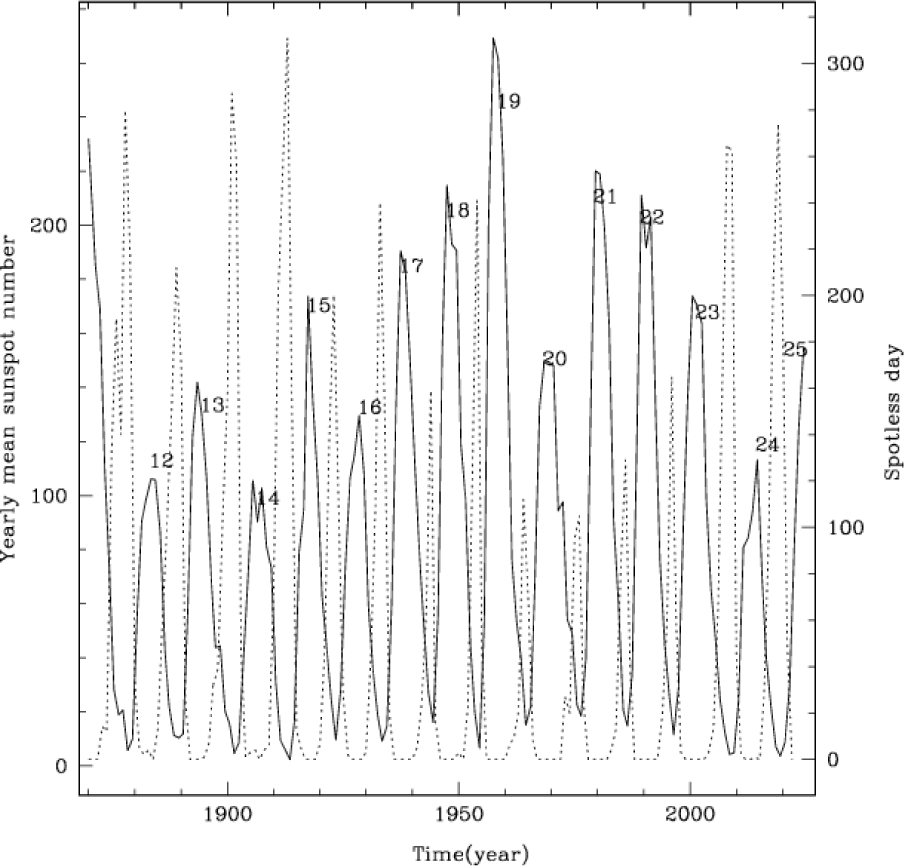
In Fig. 1, we show the yearly sunspot number and number of spotless days from 1870 to 2025. This time-interval includes the period from the maximum of solar cycle 11 to maximum of solar cycle 25. The vertical axes on the left and right stand for the mean sunspot number in year and yearly number of spotless days, respectively. Solid and dotted lines represent the yearly mean sunspot number and number of spotless days in year, respectively. Besides the 11-year solar cycle, a long-term variation in sunspot number can be seen. Obviously, more spotless days occur around minima of the 11-year solar cycle and there are none around solar maxima. In general, the temporal distribution of spotless days is different from each other as sunspot numbers do. It is interesting to note that when a large number of spotless days occurs during solar minimum the following cycle tends to be weak, and vice versa. This is true indeed, except the solar cycle 19. In addition, it may be seen that the profile of spotless-day distribution has a skewed shape in common. As a cycle is coming to its end, the number of spotless days slowly grows, and then rapidly decreases soon after peaking at solar minimum when a new cycle begins. In other words, spotless days occur for a more prolonged period during the descending phase of solar cycle than the ascending phase. We consider that this apparent trend could be somehow related to the shorter periods of rising and longer periods of decaying in the 11-year solar cycle. Therefore, as the Waldmeier relation implies, it should be interesting to investigate whether the statistical properties of spotless-day distribution, such as a skewedness, is correlated with the solar maximum activity.
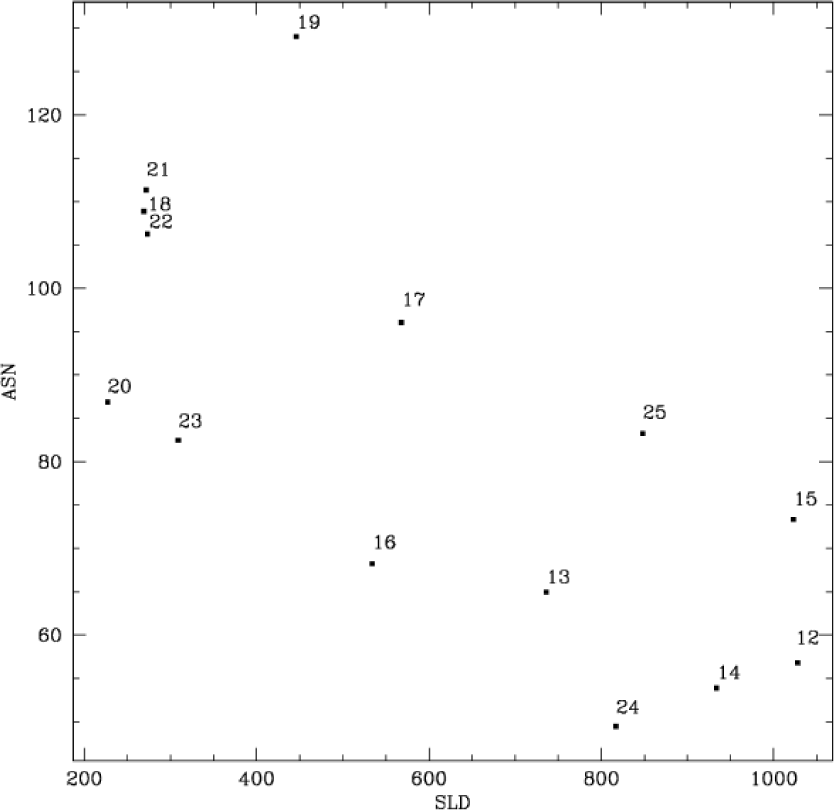
In Fig. 2, we show a scatter plot of average of sunspot numbers (ASN) for i-th solar cycle and number of spotless days (SLD) occurring during the time-interval from maximum of (i – 1)th cycle to maximum of i-th cycle. That is, the number of spotless days has been counted around the minimum period, or the beginning of a particular solar cycle. According to this scatter plot, as noticed in Fig. 1, it turns out that weak solar cycles tend to be preceded by solar minimum with numerous spotless days. To quantify the correlation coefficient, we calculate the Pearson’s linear correlation coefficient between ASN and SLD, resulting in –0.72 with the rejection probability of ~0.1%. For comparison, instead of ASN, we repeat the calculation using the yearly mean total sunspot number at solar maximum for a given solar cycle, and find the linear coefficient of –0.72 with the null probability of ~0.7%. That is, it is concluded that a significant anti-correlation exists between the number of spotless days and solar activity level. Hence, we suggest that the number of spotless days during solar minimum can be a promising sign of the maximum level of solar activity.
4. CORRELATIONS OF OCCURRENCE RATE OF SUNSPOT
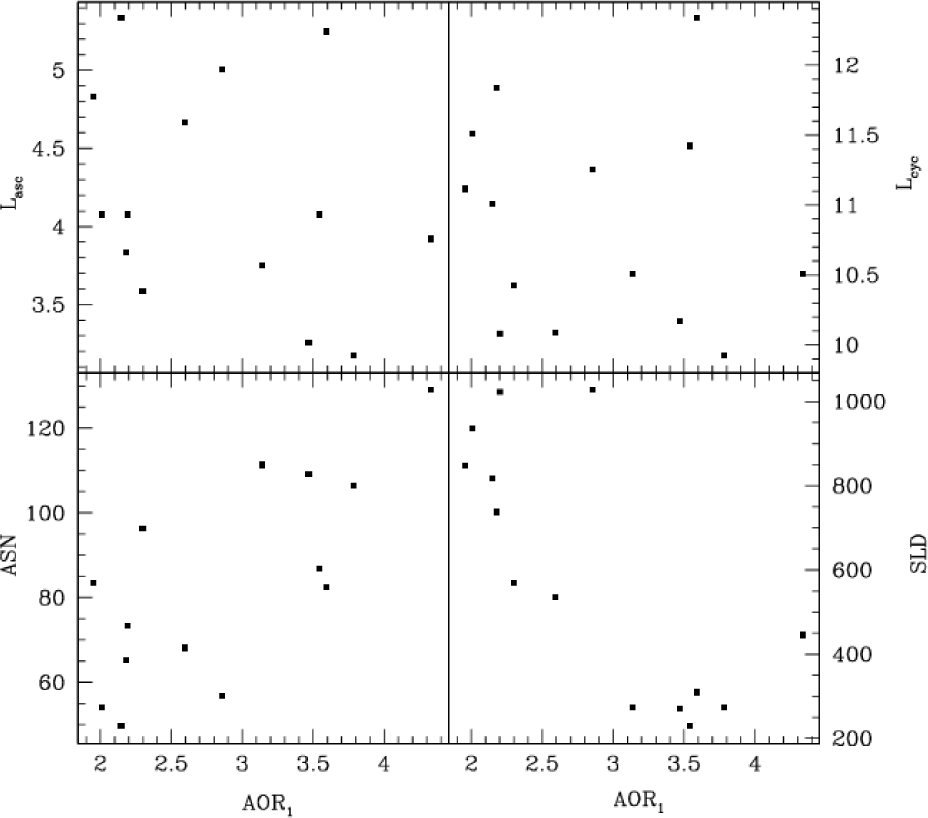
In Fig. 3, we show scatter plots of occurrence rate of sunspot averaged over the period from the maximum of (i – 1)-th solar cycle to maximum of i-th solar cycle (AOR1) versus ASN, number of SLD, length of ascending phase (Lasc), and length of solar cycle (Lcyc) for the corresponding i-th solar cycle. Here, we remind that the occurrence rate of sunspot in a particular month is calculated by dividing the monthly sunspot number by the number of active days in the corresponding month. From these plots, AOR1 is not found to correlate with Lcyc, nor Lasc. While AOR1 is anti-correlated with SLD, and is correlated with ASN. In Table 2, Pearson’s linear correlation coefficients are listed along with the rejection probability in parentheses, confirming that the correlation (anti-correlation) exits between averaged occurrence rate of sunspot and sunspot numbers (number of spotless days). Specifically, the correlation coefficients between AOR1 and ASN, and between AOR1 and SLD result in 0.73 with the rejection probability of ~0.1%, and –0.76 (0.1%), respectively. Again, we repeat the calculation using the yearly mean sunspot number in the year of solar maximum for a specific solar cycle (SNmax), indicated that the conclusion remains unchanged. On the one hand, the averaged occurrence rate of sunspot does not remain uniform across solar cycles and varies proportional to solar activity. On the other hand, the more spotless days occurs, the higher the occurrence rate of sunspot is to catch up with. Our finding implies, therefore, that the averaged occurrence rate of sunspot varies cycle-by-cycle.
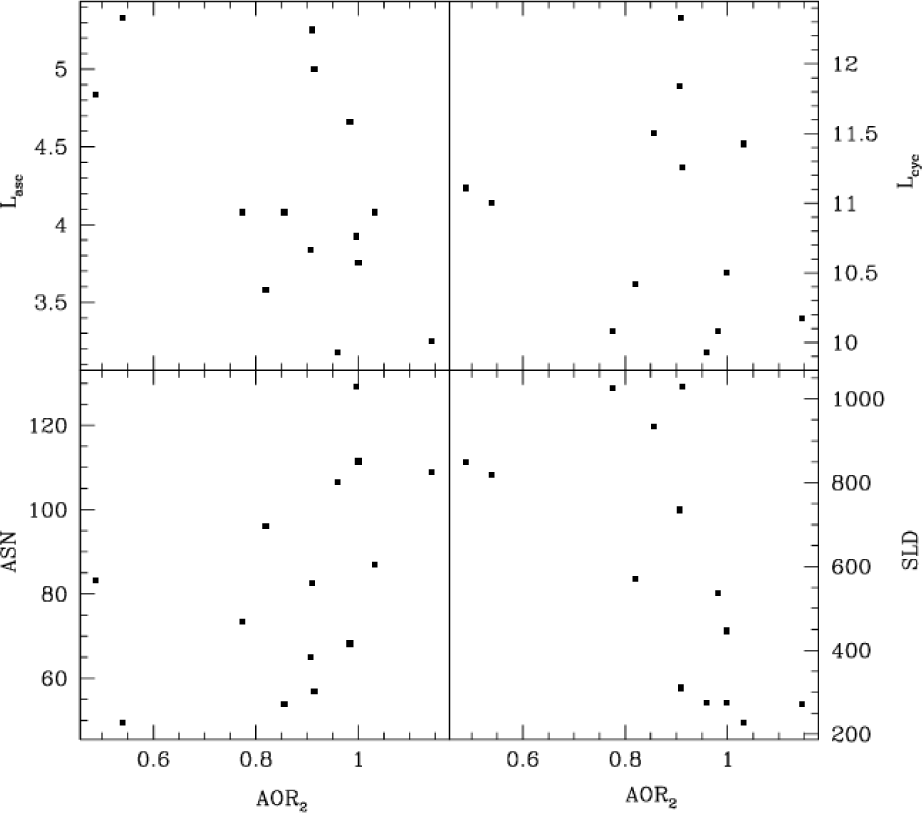
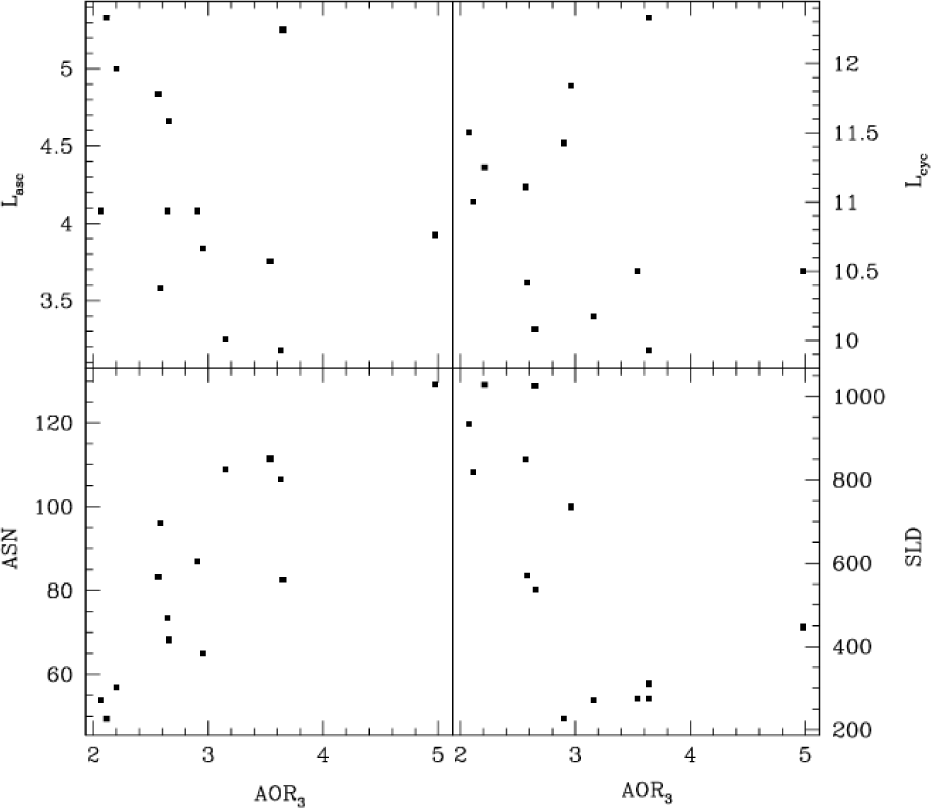
SLD, spotless days; SNmax, maximum for a specific solar cycle; ASN, average of sunspot numbers; Lasc, length of ascending phase; Lcyc, length of solar cycle; AOR1, occurrence rate of sunspot averaged over the period from the maximum of (i − 1)th solar cycle to maximum of i-th solar cycle; AOR2, occurrence rate of sunspot is averaged over the solar-minimum period defined as the solar minimum ± 1.5 yr; AOR3, occurrence rate of sunspot is averaged over the period of the ascending phase of a given solar cycle.
In Fig. 4, similar to Fig. 3, we show scatter plots resulting from averaged occurrence rate of sunspot is averaged over the solar-minimum period defined as the solar minimum ± 1.5 yr (AOR2). The averaging has been done over the period defined as ± 2.5-years centered around the dates of solar minima that can be found in Table 1. Based on Fig. 3, we have found that the averaged occurrence rate of sunspot modulates as a function of solar cycle with the timescale of ~11 yr. Here, we aim to examine in what part of the cycle the averaged occurrence rate begins to contribute to such correlations. To achieve this goal, we choose the sub-interval dominated by spotless days, after separating the duration of solar cycle into two sub-intervals depending on whether the period is dominated by spotless days or not. Note that, as mentioned above, almost all of spotless days occur around the beginning of solar cycle. For these particular plots, we set the minimum period as the solar minimum ± 1.5 yr, and accordingly reduce the interval, over which the averaging is performed. Results shown in Fig. 4 and Table 2 indicate that correlation between the AOR2 and ASN becomes marginal. Specifically, the correlation coefficient between AOR2 and ASN results in 0.48 with the rejection probability of ~4.0%. In the meantime, correlation between the AOR2 and SLD does not change significantly. That is, the correlation coefficient between the AOR2 and SLD result in –0.63 with the rejection probability of ~0.7%. Hence, it is concluded that the occurrence rate during active days appears to more significantly contribute to correlation between the averaged occurrence rate and sunspot number than during spotless days. As in the case of AOR1, AOR2 is not found to correlate with Lcyc, nor Lasc.
In Fig. 5, similar to Fig. 3, we show scatter plots resulting from averaged occurrence rate of sunspot is averaged over the period of the ascending phase of a given solar cycle (AOR3). Here, we further aim to determine in what phase of solar cycle this cycle-dependent reinforcement contributes to such correlations in the number of sunspots. For these particular plots, we have set the averaging interval as the one from minimum of i-th solar cycle to maximum of i-th solar cycle, corresponding to the ascending phase of i-th solar cycle. Results summarized in Table 2 indicate that correlation between the AOR3 and ASN is significantly high, and same for SNmax. Specifically, the correlation coefficient between AOR3 and ASN results in 0.84 with the rejection probability of ~0.0%. Correlation between the AOR3 and SLD is also significant, i.e., –0.64 (0.6%). As in the cases of AOR1 and AOR2, AOR3 is not found to correlate with Lcyc, nor Lasc. Hence, it is concluded that the averaged occurrence rate is correlated with sunspot number even in the ascending phase of solar cycle.
5. CONCLUSIONS
Sunspots are one of the most prominent manifestations of the solar magnetic fields. Thus, it is crucial to keep on monitoring sunspots and understand how the characteristics of observed sunspot records evolve in terms of not only statistics but also physics. As solar minimum with numerous spotless days is generally followed by a weak solar cycle, one may expect that solar cycle with a large number of spotless days becomes weak owing to either a small number of active days during solar cycle and/or a lower occurrence rate per day during active days of solar cycle. Here, we have statistically analyzed daily sunspot data to examine whether the averaged occurrence rate of sunspots varies, showing any dependence on solar cycle.
According to our analysis, we have found that the AOR1 is negatively correlated with the number of spotless days, and is correlated with sunspot numbers. While AOR1 does not correlate with length of solar cycle, nor length of ascending phase. Meanwhile, the occurrence rate during the active period appears to more significantly contribute to correlation between the averaged occurrence rate and sunspot number than during less active periods. It is also pointed out that the averaged occurrence rate is correlated with sunspot number even in the ascending phase of solar cycle. The result of our analysis implies, therefore, that statistical behaviors of the occurrence rate of sunspots should be explained by any theory for the solar dynamo model. For example, not only the solar magnetic fields generated by any dynamo action but also the density of it should be cycle-dependent.
Lastly, it is important to remind the fact that the profile of spotless-day distribution is skewed. As solar cycle tends to be strong when the rise time is short, a rapid decrease in the number of spotless days during the ascending phase is expected to be subject to solar activity. Hence, we suggest the statistical properties of spotless-day distribution is worthwhile to revisit for further investigation to test whether it can play a role in predicting the maximum level of solar activity.


